Linguistic Awareness
Linguistic Awareness
Purpose
This badge will expose students to the National Council of Teachers of Education's (NCTE) statement regarding the place of dialect in the classroom and explain to tutors how dialect prejudice can be harmful in ways that affect not only students' writing but their identity as a dialect speaker. The badge concludes with practical applications the tutors can employ in sessions when helping students who come with dialectal variation questions within their writing samples.
LET'S GET STARTED
Dialect is the idea of how all language changes over time, in terms of lexicon, sound structures, tone, rhythm, the way sentences are put together, the social markings of variants, and the meanings assigned to words, with each of these functions taking place in a person's speech to form his or her dialect.
Each dialect is inherently tied to a person's culture, identity, and history.
Linguistic prejudice is a real issue around the world and has had many effects on people who have a dialect that differs from others' norms. Being linguistically prejudiced towards a person is the equivalent of being discriminatory towards a group of people (i.e. racism, sexism, homophobia, etc.).
Why is dialect important?
Dialect is important because it is a part of a person's identity. It showcases our cultures, families, homes, values, race, gender, and sexual orientation, all of which make up our individual kits – our senses of self.
The following is a statement from NCTE with regards to dialect. Click the play button on the media player below to hear it read with a dialectal variation.
We affirm the students' right to their own patterns and varieties of language — the dialects of their nurture or whatever dialects in which they find their own identity and style. Language scholars long ago denied that the myth of a standard American dialect has any validity. The claim that any one dialect is unacceptable amounts to an attempt of one social group to exert its dominance over another. Such a claim leads to false advice for speakers and writers, and immoral advice for humans. A nation proud of its diverse heritage and its cultural and racial variety will preserve its heritage of dialects. We affirm strongly that teachers must have the experiences and training that will enable them to respect diversity and uphold the right of students to their own language.
– National Council of Teachers of Education
Common Dialect Features
Southern American English (SAE) and African American English (AAE) are two of the most stigmatized dialects at Coastal Carolina University according to our first year writing survey. Years of research on dialects of English have identified these as some of the most common and recognizable linguistic features of SAE and AAE. You may notice some of the sound examples occurring in the spelling within student writing. Likewise, the grammar examples often appear in the sentence structure of student papers. These are regular, predictable, and rule governed linguistic features of these dialects and should be addressed with care and respect. You also may print this to keep and use during student tutoring sessions (download the file here).
Southern English
- Sounds
- The r sound
- R sound may be absent of partly absent
- -ing and –in alternation
- -ing becomes unstressed and ends up sounding like –in.
- Ex.: running translates to runnin'.
- -ing becomes unstressed and ends up sounding like –in.
- The ai sound (sounds like "I")
- The merging of ah or ai sounds.
- Ex. time sounds like tom; tire sounds like tar.
- The merging of ah or ai sounds.
- The oy sound (as in "boy")
- The oy sound may be pronounced as oh when it occurs before an l.
- Ex. oil may be pronounced as oll or all.
- The oy sound may be pronounced as oh when it occurs before an l.
- The "pin"-"pen" merger
- Lax i and e vowel sounds similar when in front of nasal sounds n, m, and ng.
- Ex. pen may be pronounced as pin; Jenny may be pronounced as Ginny.
- Lax i and e vowel sounds similar when in front of nasal sounds n, m, and ng.
- The r sound
- Grammar
- Ain't
- Ain't is often used as a helping or linking verb. Ain't is used in the place of am not, isn't and aren't.
- Ex. I ain't doing that.
- Ain't is often used as a helping or linking verb. Ain't is used in the place of am not, isn't and aren't.
- Multiple negative
- Even those these sentences are deemed as unfit for academia, they are still very understandable.
- Ex. He don't know nothing or I ain't seen him neither.
- Even those these sentences are deemed as unfit for academia, they are still very understandable.
- Absence of plural markers
- For nouns of weight or measurement, the plural marker becomes optional.
- Ex. four pound, twenty mile, three foot.
- For nouns of weight or measurement, the plural marker becomes optional.
- Fixin' to
- Means about to, getting ready to, or planning to
- Ex. It looks like it's fixin' to rain.
- Means about to, getting ready to, or planning to
- A-prefixing
- An a-prefix is attached to words—it is pronounced uh
- Ex. I went a-runnin' to the store.
- An a-prefix is attached to words—it is pronounced uh
- Ain't
African American English
- Sounds
- Ask
- Ask is usually pronounced as axe
- Ex. I axed ha a question.
- Ask is usually pronounced as axe
- The th sound
- Usually pronounced as a d sound
- Ex. that = dat, these = dese.
- Usually pronounced as a d sound
- Consonant blends
- Reduction of sk, nd, ts, kt, sts and sks sounds
- Ex. lists = liss, best = bess
- Reduction of sk, nd, ts, kt, sts and sks sounds
- Ask
- Grammar
- Habitual or invariant forms of be
- Often known as habitual be.
- Uses invariant be to convey habitually in a way that does not require the addition of certain words.
- Ex. "The students be missing class when the bus comes late" versus "The students typically miss class when the bus comes late."
- The call –self construction
- Involves the verb to call plus a personal reflexive pronoun.
- Describes a situation in the opinion of the speaker.
- Ex. "He calls himself cooking."
- Stressed been
- Pronounced bin
- Paired with a main verb in the simple past tense and indicates that an event has happened in the remove past, a long time prior to the present time
- Ex. "I been finished my homework."
- Absence of –s inflections
- Absent in third-person singular verb forms.
- Ex. "He talk too much" versus "He talks too much."
- Absent in possessive constructions.
- Ex. "Look at John hat" versus "Look at John's hat."
- Absent in plural constructions.
- Ex. "Give me 50 cent" versus "Give me 50 cents."
- Absent in third-person singular verb forms.
- Existential it
- It is used to denote the existence of something in a way that it is generally equivalent to the use of there is, there's, or there are.
- Ex. "It's a pencil in the drawer" versus "There's a pencil in the drawer."
- It is used to denote the existence of something in a way that it is generally equivalent to the use of there is, there's, or there are.
- Habitual or invariant forms of be
Watch this short video about dialect prejudice with Dr. Becky Childs (Associate Professor) and Dr. Daniel Hasty (Assistant Professor) at Coastal Carolina University.
(Here is a related video that deals with dialect prejudice and linguistic discrimination)
Dialect at CCU
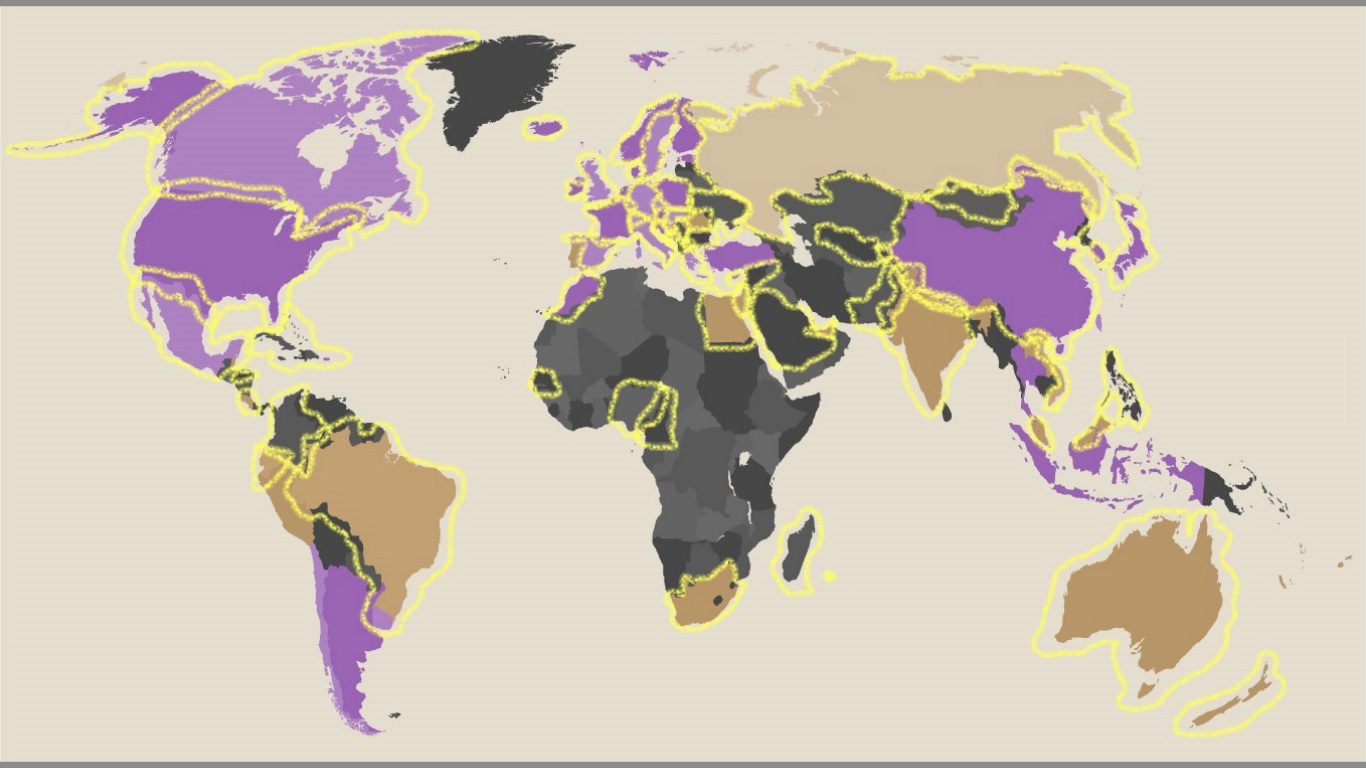
Fall 2014 enrollment statistics indicate that the majority of the CCU undergraduate population consists mostly of students who identify as having a white or caucasian background (74.1%), followed by black/African-American (20.8%), Hispanic (3.8%), Asian (1.9%), American Indian/Alaskan Native (.9%), and Native Hawaiian/Pacific Islander (.3%). Students of two or more races account for 4.6% of this population and non-resident aliens account for 1.3%. The following map highlights the linguistic diversity that exists on our Coastal Carolina University campus.
Considerations for Writing Tutors
- Most students are most comfortable with electronic communication and texting.
- The two major concerns for young writers are their grammar and organization of the paper.
- Most students do not have a specific process while writing a paper.
- The majority of students said that their speech characteristics do show in their writing.
- Southern students were the majority to say that they have been criticized due to their speech and writing.
Assignment
Download the following PDF to your computer, and open it with Adobe Reader (Don't have Adobe Reader? Get it here for free). Answer the questions and save the file.
For citation, use:
Coastal Carolina University, Department of English, First-Year Writing Program. "Linguistic Awareness." Coastal Composition Commons, 24 August 2017, https://ccc.coastal.edu/task/linguistic-awareness/. Accessed xx xxxxxx xxxx.