Researching
Researching
What is the Research Process?
LET'S GET STARTED
"Research process" is the technical term for selecting, locating and evaluating your research materials. In English 101, you will work through a process of choosing a topic, finding information about your topic, evaluating your sources, identifying your additional information needs, and verifying your professor's research requirements. Once you have done all of that, you'll be ready to begin writing your research paper.
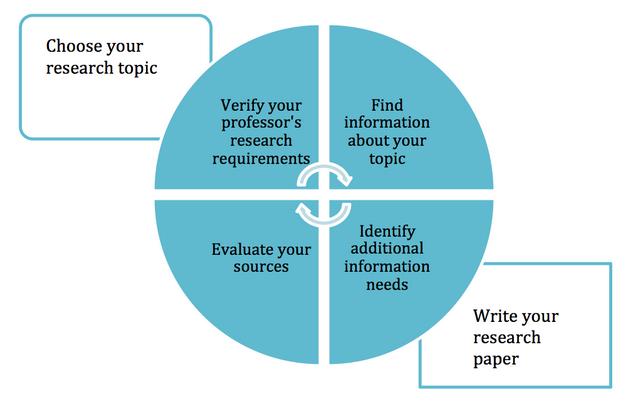
As the chart above shows, the order of this process can change. The different steps in the process can be followed more than once, but there is not really an end; it's cyclical. Still, consulting these steps will help you clarify what you will eventually write.
It is easy to get off course when searching for information. For example, you may want to immediately begin writing. If you don't first find and evaluate your sources, however, then your writing will be opinion rather than based on evidence gathered from research. You may want to select all of your sources at once, but if you do that you will not give yourself the chance to revise your topic, or you'll end up revising it (or changing it completely) after you've already spent time and energy researching your original topic. You do not have to follow the steps in the research process in any specific order but you should refer back to them all frequently so you can organize your paper and efficiently use your time.
UNDERSTANDING YOUR INFORMATION NEEDS
When you are assigned a research project, your instructor will provide you with specific guidelines. Make sure that you completely understand these requirements before you begin. If you have any questions, it is always better to ask sooner rather than later. You will want to find out:
- Length: If you are writing a paper or an essay, how many pages long does it need to be? If you are giving a presentation, how much time in class will you have to speak? This will help you figure out how in-depth your research will need to be.
- Required Sources: Are there any specific types of sources which you are required to use? For example, do you need to find books, journals, magazines, or newspapers? Do you need to use a certain number of print or online resources?
- Sources to Avoid: Are there any specific types of sources that you are not allowed to use? For example, are you allowed to use internet sources found through Google, or do all of your online sources need to come from the library's website?
- Types of Information: Are there specific kinds of information that you need to locate in these sources? For example, do you need to find statistics? Do you need to answer any specific questions?
- Topic Guidelines: Do you have an assigned topic, or will you need to choose your own? If you need to choose your own topic, are there any guidelines for what is appropriate?
CHOOSING YOUR TOPIC
Once you understand the research requirements, you will need to choose a topic. It is important to choose something that interests you so that you don't become bored or discouraged. If you're having trouble coming up with ideas, try going to the library's CQ Researcher database and browsing their reports by topic. To help you decide if a topic is a good choice for you, think about what specifically interests you about it. Is there something about the topic that you would like to learn more about?
SOURCE EVALUATION
You'll need to use Kimbel Library's online catalog and databases to find information for your research papers. It's tempting to think that a source is going to be perfect for your topic if it appears near the top of your search results. This is not always the case. Search engines like Google and library databases like Academic Search Complete give you results based on what they interpret as relevant. There is no guarantee that the first source you see will be useful to your topic. It is necessary to evaluate each source before using it.
Start by asking yourself:
- What kind of source is this? Is it a book, an article from a journal or magazine, or a blog post, etc.?
- Who is the audience for this source? Is it the general public, academic, or professional?
- Is the source appropriate for your assignment? Check your syllabus and/or instructions to make sure.
- Does this source contribute to the topic you are researching? Skim the source to find out if the information is relevant to your topic.
If you're searching for sources in Kimbel Library's website, you'll notice clues in the record for each book or article that will help you answer the questions listed above.
FURTHER EVALUATION
Once you've found some sources for your topic, you'll need to evaluate them for suitability for your research paper. On pages 20-21 of your First-Year Composition Guide, you'll find instructions for using the C.R.A.A.P. test to evaluate sources. The C.R.A.A.P. test is a quick and easy method of deciding whether or not a source is worthy of being included in your research paper.
With the C.R.A.A.P. test, you will analyze your source for:
- Currency (How old is the source?)
- Relevance (How does the source relate to your topic?)
- Authority (Who wrote or published the source? You may want to read the author's biography.)
- Accuracy (Is the information in the source trustworthy?)
- Purpose (Why does this source exist?)
If a source doesn't meet all the criteria of the C.R.A.A.P. test, you should not use it in your research paper. Keep searching and evaluating until you find relevant sources for your information needs.
Since the C.R.A.A.P. test only looks at the source itself, you also may want to employ a technique called lateral reading. In lateral reading, you look at outside sources to find out more about the reputation of the source you are evaluating. To do a lateral reading of your source, try doing these things:
- Google the name of the publication or website. Can you find information about it in other trusted sources? Does the information you find match with what the source is telling you about itself?
- Google the author of the source. Can you verify any credentials they listed? Can you find out more about their expertise from another source?
- Look for information about the source's reputation through Google. Is it generally trusted to be a source of reliable information, or do others point out potential problems with the information found there?
- If your source cites other sources, pick one and look for it online. Did they cite the source correctly, or did they quote from it out of context?
KEY POINTS TO REMEMBER
The research process is the way we select, locate, and evaluate research materials. The steps in the research process are cyclical. Consulting them will remind you to:
Find information about your topic
- Evaluate your sources
- Identify additional information needs
- Verify your professor's research requirements
It is important to make sure you understand your research requirements. CQ Researcher is a good database to help you find research paper topics and related articles. Evaluate your sources by examining their records, and apply the C.R.A.A.P. test to determine:
- Currency
- Relevance
- Authority
- Accuracy
- Purpose
For citation, use:
Coastal Carolina University, Department of English, First-Year Writing Program. "Researching." Coastal Composition Commons, 24 August 2017, https://ccc.coastal.edu/task/research-2/. Accessed xx xxxxxx xxxx.