Shaping A Thesis
Shaping A Thesis
WHAT IS A THESIS STATEMENT?
When you hear the phrase "thesis statement," what comes to mind? Most likely, you think of a few rules: thesis statements should provide readers with a clear sense of both your topic and what you intend to say about that topic. It is housed in one or two sentences, usually found at the end of your introductory paragraph. While it is safe to assume that a thesis statement is something teachers look for when they read your writing, your thesis is more than this. Your thesis is the approach you plan to take in your writing; it is the point or argument you want to make and develop.
Thesis statements are often confused with the topic of a paper, of an idea. When instructors ask, "What's your thesis?" during the drafting process, they frequently get a topic in response; a student may say something like "homelessness." But homelessness is a topic, not a thesis. Homelessness, on its own, isn't a stance you can develop or a point you can make. Thoughts on a topic without a guiding thesis do not make an essay. They make a mess.
WHY DO WE USE THESIS STATEMENTS?
In reality, a thesis should provide you and your readers with a sense of direction in a paper, of the kind of points you plan to make and of the kinds of evidence you will draw upon to develop your piece. This only happens when you come to a rich sense of what you want to write about (your topic) and what you want to say about that concept (your perspective or angle).
WHAT DOES A THESIS STATEMENT LOOK LIKE?
Research on attitudes about global warming suggests that to slow the development of coastal areas, we must create a more informed public that more fully understands the implications of some current and proposed projects. Creating a common and well established school curriculum on global warming and its consequences is the best way to enact change.
Notice how the writer first mentions "global warming" to show readers the main topic that will be explored. Then the writer states the "development of coastal areas," which are the aspects of the main idea that will be explored. The writer mentions that "we must create a more informed public that more fully understands the implications of some current and proposed projects" in order to show the type of evidence that will be used and the line of thinking that the writer has developed. And, lastly, "Creating a common and well-established school curriculum on global warming and its consequences is the best way to enact change" shows the reader how the writer will use his or her evidence and what the writer wants readers to realize. As the whole example shows, a thesis should give readers a clear sense of what your paper will be about and its specific focus. It should also outline a project that fits the scope of your assignment. Remember that you're not just sequentially assembling the answers to these questions, but creating a cohesive blend of the answers to form a thesis that makes sense within your paper.
OKAY, SO HOW DO I CRAFT A STRONG THESIS STATEMENT?
When you are asked to write an essay, you are being asked to make, develop, and support a specific point. An unsuccessful essay may have many points rather than one, or it may have a single point that is simply not very interesting or specific. By composing a strong thesis statement, you will be more confident that your essay has a single, specific, and worthwhile central point.
A thesis statement, however, is not always something you compose once and for all. Your thesis statement can be changed and revised as you become more and more informed about your topic and the points you want to make. As you read and consider what others have said about your topic, you will come to realizations about it as you present and discuss evidence. Then, you should revise your thesis according to what you've learned. In fact, good writers often revise their thesis statements several times as they compose, making their thesis statements stronger and more accurate with each revision. These "back and forth" revisions based on new things you've learned is part of what we call "the recursive writing process."
Having said that, thinking about your thesis statement early and often is a helpful practice when writing — even if you are writing a piece that doesn't require a traditional thesis statement, like a narrative. Considering a series of questions like the ones below can help.
- What topic will I explore in this paper?
- What aspects of this topic will I address in this paper?
- What kinds of sources will I use to learn more about this focus?
- How will I use evidence in this paper?
- How might I develop my line of thinking in this paper?
- What do I want my readers to realize when reading my work?
While the scope of these questions might seem to extend beyond a traditional thesis statement, and while you certainly won't be able to "fit" all of the information you generate from this exercise into your thesis, addressing these as you conceptualize a project will help you think carefully about what points you want to make in a paper and how you want to make them. Further, you may want to return to these questions when you begin drafting your paper, as they will help you refer back to your thesis.
Let's look at some possible topics:
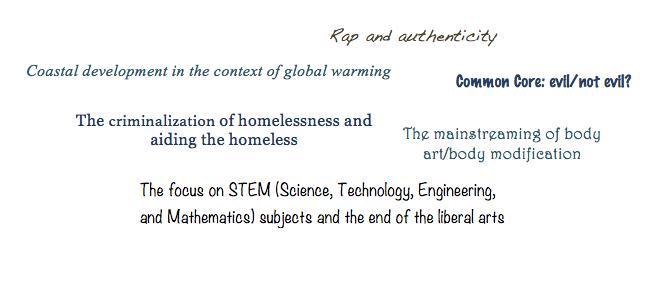
Selecting a topic for a paper allows you to determine what it is you will focus on as you write a piece. In some classes you will have more freedom than in others, but you will always want to try to carve out some element of a topic that is of particular interest to you. Finding an "in" or a point of interest in a particular topic makes the process of writing a thesis smoother. Even if you have to do some initial digging, it's definitely worthwhile to carve out that point of interest.
Say you are in a class that asks you to write about the first topic, which focuses on coastal development in the context of global warming. (Over the next several decades, global warming will likely have many impacts on coastal development. For example, rising sea levels may affect where houses should be built, how structures are insured, how people should prepare for more and bigger storms, and so forth.) Imagine you are an education major, and you're not all that interested in coastal development or global warming. How can you shape this topic so it becomes something you can actually want to learn more about? Use the set of questions provided above to collect some ideas. That might look something like this:
WHAT TOPIC WILL I EXPLORE IN THIS PAPER?
The paper needs to be about coastal development and global warming, but I would like to be able to connect this to education in some way. Maybe I will try to focus on how attitudes seem to develop about global warming and then consider the implications for coastal development.
WHAT ASPECTS OF THIS TOPIC WILL I ADDRESS IN THIS PAPER?
In addition to considering how attitudes are developed about this topic, I will also connect this to education. So, I will question how particular teaching approaches can help increase an awareness of global warming that would slow coastal development. I could then talk about this based on what I learn about how attitudes are formed.
WHAT KINDS OF SOURCES WILL I USE TO LEARN MORE ABOUT THIS FOCUS?
My focus on attitudes will allow me to use a variety of sources. I will want to find some scientific sources that focus on global warming itself. Then I need some information about what people believe (and don't believe) about this topic. These articles could come out of scientific journals, but I might also look at pieces from authoritative print publications and reputable online sources.
HOW WILL I USE EVIDENCE IN THIS PAPER?
In addition to using summaries, paraphrases, and quotations from the primary sources I will find, I also want to create a survey that asks how people learn about global warming and their attitudes about coastal development.
HOW MIGHT I DEVELOP MY LINE OF THINKING IN THIS PAPER?
What I need to do in this paper is establish that our attitudes about global warming (and, as a result, coastal development) are informed by our attitudes about the topic. So, if we want to decrease coastal development, we need to use education to create an informed public.
WHAT DO I WANT MY READERS TO REALIZE WHEN READING MY WORK?
After reading my paper, I want my readers to think the school systems need to create curricula that focus on global warming so people know more about this topic and can make better informed decisions about future developments.
WHAT IF?
What if my thesis actually changes as I write a paper? What if my ideas change so much while I examine my topic through research and writing that I have to change my topic? That is fantastic! Be flexible as you write and see this as a process grounded in inquiry. A revised thesis statement is potentially a strong one.
For citation, use:
Coastal Carolina University, Department of English, First-Year Writing Program. "Shaping A Thesis." Coastal Composition Commons, 24 August 2017, https://ccc.coastal.edu/task/shaping-a-thesis/. Accessed xx xxxxxx xxxx.