Imagining Readers
Imagining Readers
WHAT IS AUDIENCE AWARENESS?
In writing, audience awareness is the name for the knowledge writers gain about their audience as they imagine their readers while they are planning what and how to write. Although gaining audience awareness is a vital early step in any writing situation, it is especially crucial when you need to plan how to revise a document or message to be more effective for a different group of people.
As a writer, imaging your readers is much like preparing for a move to a new neighborhood or community. You would never relocate to a strange neighborhood without first getting to know a bit about the community and who your neighbors are. To reduce the chance of miscommunication, you would first want to find out what the people were like generally — basic things like their beliefs, interests and expectations. Otherwise, your new neighbors might give you the cold shoulder or, in some cases, get angry at you for being disrespectful. More specifically, some neighborhoods share certain expectations about how to communicate with the people who live there. Just like certain neighborhoods might prefer a certain style of speech or tone of voice, different audiences often have different expectations about how they want to be communicated with.
WHY IS IMAGINING READERS IMPORTANT FOR WRITERS?
Being a writer faced with a new audience is much like being a stranger in a new community: if you don't attempt to understand and meet the basic expectations of the community, you won't make friends with your "new neighbors". They might misunderstand you or your intentions for being in their community. And for a writer, not making friends means your original message ends up not being communicated effectively to this new audience. So, for example, your new audience might seriously misunderstand you because you left out a detail they really needed to know. Or your new audience might be bored or left unpersuaded by a claim because you included details that were irrelevant to their interests or beliefs. In fact, you could even offend your new audience if you don't take the time to consider your tone of voice and writing style and how they will be received by this new audience.
So, in short, becoming more aware of your audience can make you more responsive to your readers' expectations. And being more responsive to your readers will likely make your writing more powerful. This power allows you to more fully accomplish the overall goal or purpose of your writing by giving you strategies to carefully take into account different needs and expectations of who you're writing to.
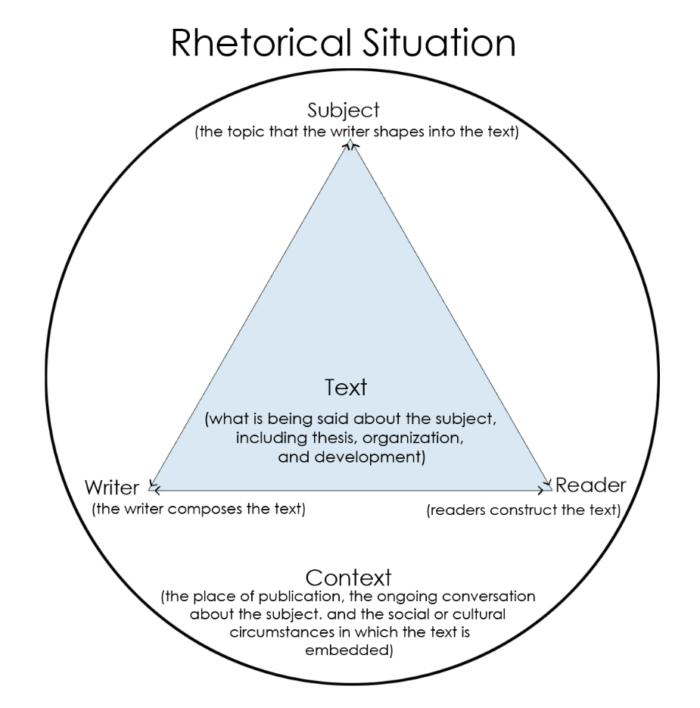
The relationship between the audience, the writer, and subject is known as the rhetorical situation.
HOW DO I KNOW WHO MY AUDIENCE IS?
Unlike when we speak, our audience is rarely present when we write, and so we must learn to anticipate their interests (what do they want?), values (what do they believe?) and expectations ("What do they need from you?") in order for us to properly tailor our ideas to them. This process is what we mean by "Imagining Readers". To better imagine our readers, consider the following three areas: Demographic, Disposition, and Knowledge.
- Demographic. Who is my audience?
- What is the general age of my audience?
- What is their cultural, social, and economic background?
- Are they religiously and/or politically affiliated with a certain group?
- What sorts of occupations might they have?
- What sorts of racial and/or ethnic groups are represented?
- Disposition. What does my audience care about?
- What sorts of general concerns does my audience have?
- What kinds of problems do they regularly face?
- What kinds of expectations are they bringing to this text?
- Do they have an biases I should take into consideration?
- Knowledge. What does my audience already know?
- How much does my audience already know about this issue?
- What do they need to know about it?
- How are they likely to use this information?
- How is this information likely to benefit them?
IS THERE A RIGHT WAY TO COMMUNICATE TO ANY AUDIENCE?
Contrary to what many of us are taught when we are young, there is no "right" way to communicate, only "different" ways depending on the needs of a specific rhetorical situation.
Linguists call this kind of change between multiple ways of speaking code switching, and it is especially noticeable in spoken communication. When sending an email to an employer, we tend to be more aware of our word choices, spelling, and organization than we would if we were emailing a friend. We might focus on matters that appeal to that employer's position of authority (our work output, profits, etc.), whereas in an email to a friend we might focus on more personal matters (complaints about coworkers, weekend plans, etc.). We would code-switch between these audiences in terms of language, tone, and even format.
So tailoring your writing to specific readers can be tricky if you haven't analysed your audience using the questions above, but not doing so can result in your message coming across in ways you didn't want or, in some cases, not coming across at all.
For citation, use:
Coastal Carolina University, Department of English, First-Year Writing Program. "Imagining Readers." Coastal Composition Commons, 24 August 2017, https://ccc.coastal.edu/task/shifting-styles-ii/. Accessed xx xxxxxx xxxx.